
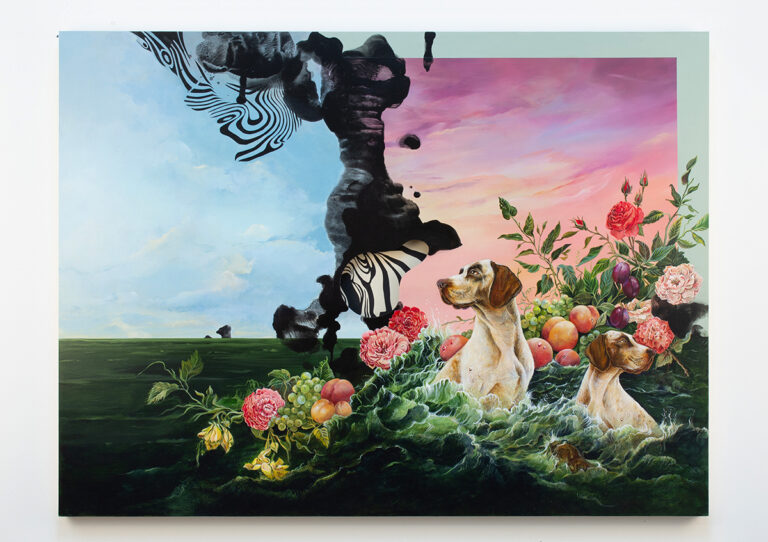
Joerg Dressler, Wild Companions, 2026. Acrylic on panel, 30” x 40”. All photos courtesy Joerg Dressler
Seduction and disruption drive Joerg Dressler’s paintings. I haven’t seen his latest show, WildCompanions, at Alden Gallery through August 20, but for years I’ve tracked his trajectory of reframing beauty. He anchors his pieces in swoon-worthy landscapes that borrow from art history. The old landscapes are rooted firmly in his own past, as well as the collective one.
“[G]rowing up in Germany, my parents introduced me to European art history by taking me to museums such as the Städel Museum in Frankfurt and the Louvre in Paris.” he wrote in an email. “After some of our museum visits, I was allowed to choose a book of my own, and as a young teenager I began learning about painting by copying works from those books. Today, I reference these paintings in certain bodies of work not only because of my deep admiration for them, but also as a way of staying connected to my European heritage.”
Life has changed; it constantly does, and so has landscape painting and our human relationship to nature. Yet we can only plan based on what we know. If we’re rigid in our planning we never truly accommodate life. Joerg plans his process and then opens to the unknown. I see that in Wild Companions: the planning, the allegiance to legacy, and the breaking open to mystery.
Over time, the disruptions in his paintings have escalated from graphic interventions to more dramatic cutouts and revelations in works like Wild Companions, which Joerg writes about here. The title suggests the taut meeting place of tame and feral, order and chaos. The hounds– domesticated beasts, trained to hunt – embody that tension. The scene: A rapturous sunset seascape bumping against a placid grassy vista, both echoing idylls by Claude Lorrain. A still life of fruit and flowers spills across the picture plane – all enticing and placid. Then a jigsawslice up the middle releases plumes of black-and-white op art and thick smoke, like a genie erupting from a bottle.
The anchor of landscape remains, alluring as ever. Joerg has not destroyed it. Instead, he has complicated it in the way that knowledge and experience complicate the innocent assumptions of childhood. Violent as they are, the ruptures in his paintings are as gorgeous and absorbing as the landscapes, and just as gloriously alive.
Joerg writes:
My work of the last eight to ten years usually starts with a sketching process inPhotoshop. I have a loose idea of the elements I want to paint. My sketches can consist of photos I’ve taken with my iPhone, raw drawings of shapes and forms, as well as images I’ve researched online. Dutch still-life paintings by masters like Willem van Aelst and Jan van Huysum, as well as landscape paintings by Claude Lorrain and JohnConstable, often serve as references while I’m composing my sketches. I also draw from my background as a graphic designer, looking for juxtapositions such as active versus quiet space, engaging the margins, and letting elements “bleed” off the surface to lead the viewer’s eye.
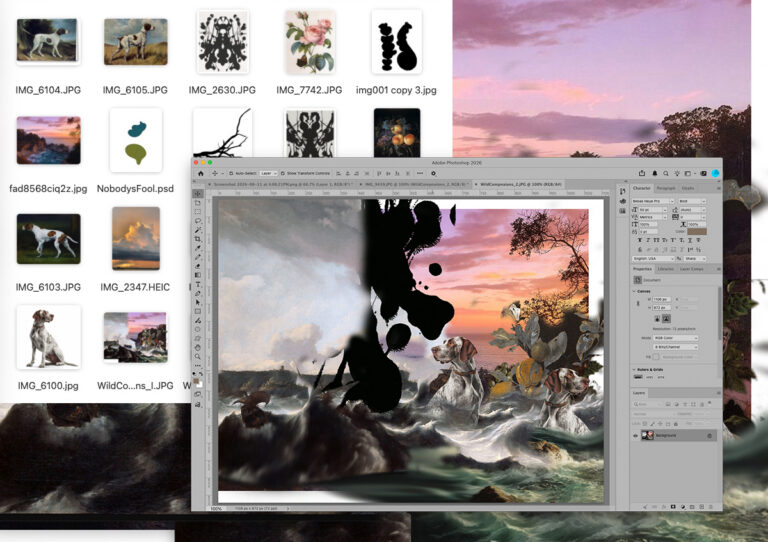
Various source materials and Photoshop sketch.
The cutouts in my recent work were the result of experimentation. While cutting organic shapes into a number of printouts of Claude Lorrain paintings, I became intrigued by stacking them and observing how the shadows changed depending on the position of the layers and the light source. By switching from canvas to wooden panels,I was able to introduce this layered approach into my painting practice. With a jigsaw in hand, the cutout shape becomes the first step in creating a new piece. Careful sanding follows, along with the application of a layer of gesso.
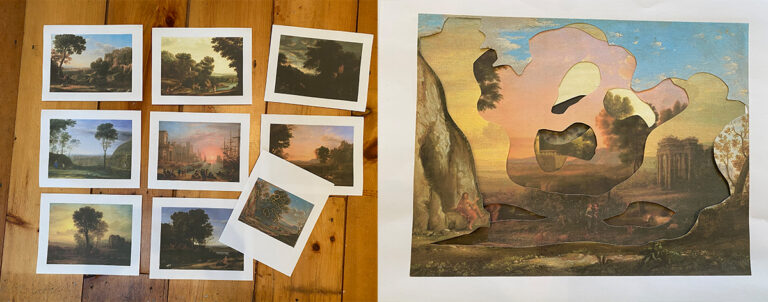
Prints of Lorrain paintings before and then stacked with cutouts
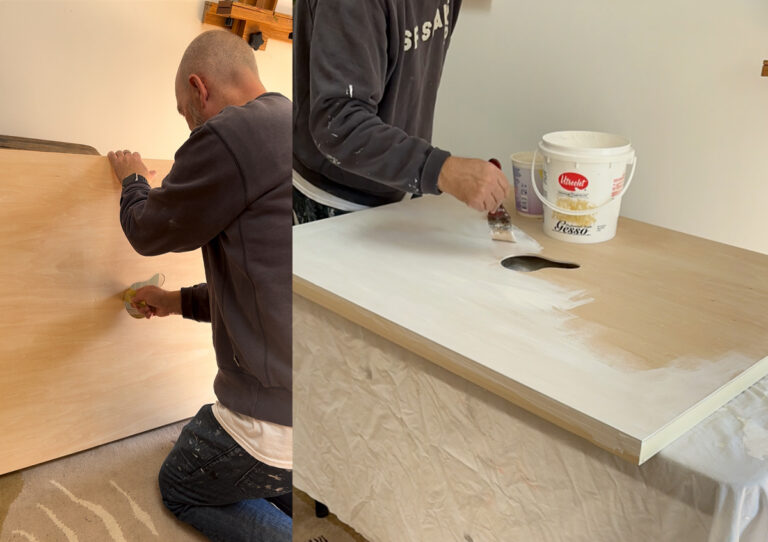
Prepping the wooden panel
While the painting process initially follows my Photoshop sketches quite closely, I often divert from them once I’m actually painting. Elements get removed while others are added. In Wild Companions, I had initially painted a silhouette of trees on the right-hand side. After making some progress, I realized the trees were competing with the still-life arrangement below. Careful but persistent sanding allowed me to erase the trees, but this also meant repainting the sunset behind them. The still-life arrangement then needed to expand to balance the composition. Similarly, I decided to abandon a margin at the bottom of the painting to create a more expansive feel.
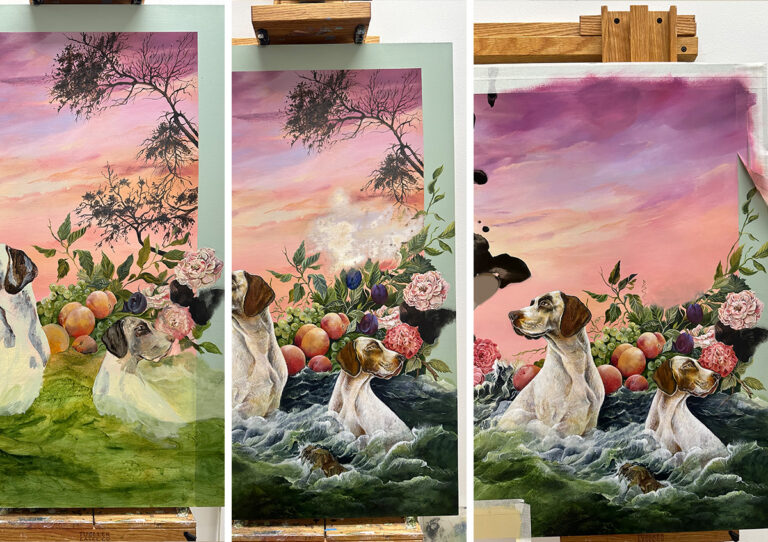
Work in process
One of the last steps for me is deciding which pattern and corresponding color combination work best for the overall composition. This can take several attempts before I find the right combination. Very often, it’s about allowing the playful to disrupt the planned. In the case of this painting, I happened to discover an old issue of the design magazine Graphis in a used bookstore. It featured the Italian designerFranco Grignani, whose black-and-white series of experiments, in which geometric drawings were stretched and distorted, seemed like the perfect match for the big, ominous paint splotch dividing the bright blue sky from the approaching sunset.
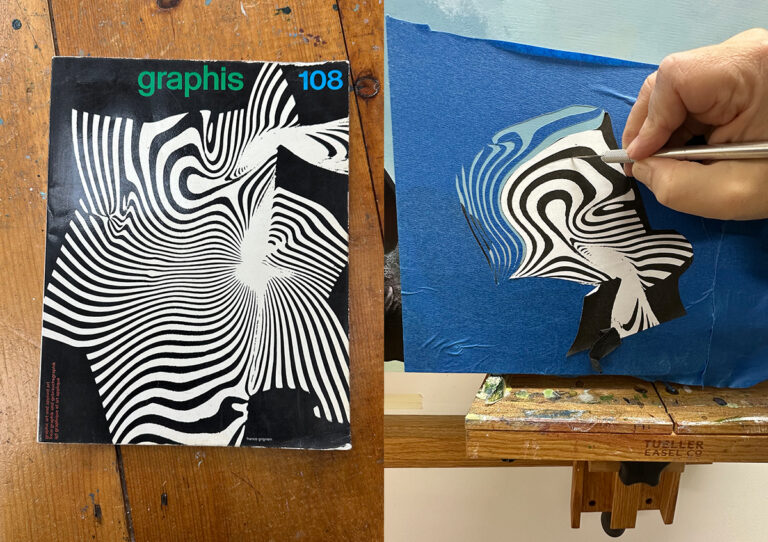
Replicating parts of Franco Grignani’s pattern with masking tape and exacto knife
Grignani’s experimental drawings turned out to be an important component of the painting, especially because I was limited in the size of the cutout by the supporting structure on the back of the panel, which I didn’t want to compromise. In this piece, the geometric pattern moves from the layer of the center cutout onto the actual surface of the painting in the upper right-hand corner. Usually, these patterns appear only within the inserted layer of my paintings.
Wild companions, 30 x40 inches, acrylic on panel, 2026—final version on studio wall
I couldn’t have reached this result if I hadn’t been open to playing with new elements that were far removed from my original sketch. That willingness to let experimentation and play disrupt the plan is an important part of how the work develops.
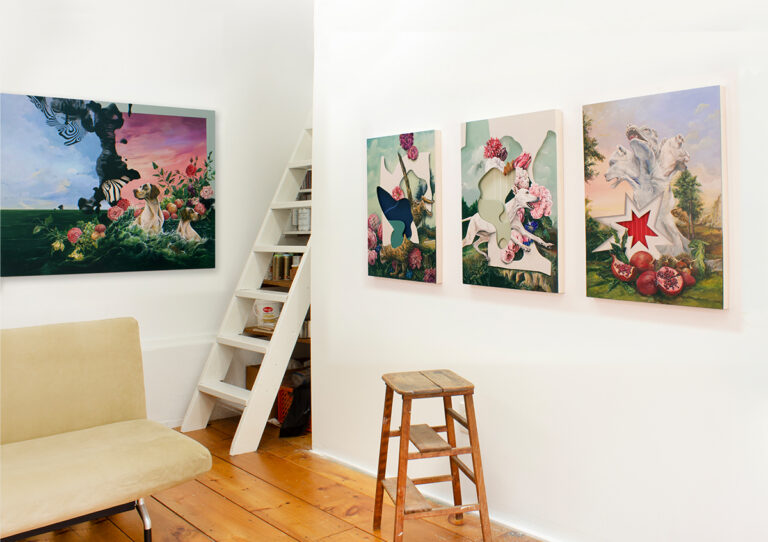
Studio view, July 2026